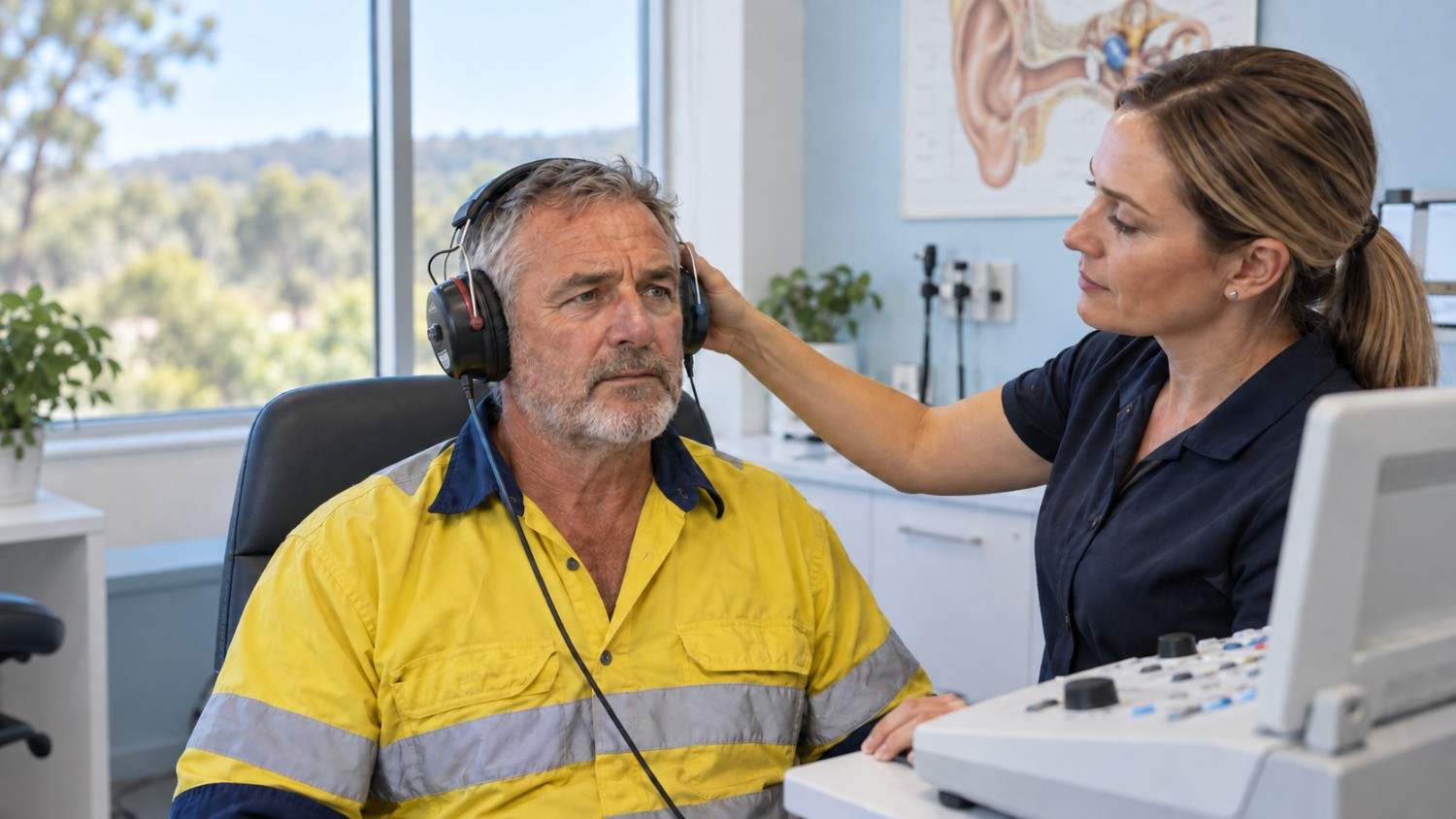
Years of exposure to loud workplace noise can contribute to permanent hearing loss and tinnitus. If you have worked around machinery, construction equipment, power tools, factories, mining equipment or heavy vehicles, you may be wondering whether your hearing loss could be work-related and whether you can make an industrial deafness claim in NSW.
The first step is understanding your hearing health.
A professional hearing assessment can identify the type and degree of hearing loss and provide important clinical information. However, a hearing test alone does not establish legal entitlement to workers compensation.
In NSW, work-related hearing impairment claims are subject to specific requirements administered by the State Insurance Regulatory Authority (SIRA).
Can You Claim Industrial Deafness in NSW?
You may be able to claim compensation for work-related hearing loss if your hearing impairment is related to employment and you meet the applicable NSW workers compensation requirements.
SIRA explains that an assessment can determine whether hearing loss is related to employment and whether hearing aids are reasonably necessary.
Factors that may be relevant include:
- Your employment history
- Workplace noise exposure
- Duration and frequency of exposure
- Hearing protection used
- Previous hearing tests
- Medical history
- Recreational noise exposure
- Audiogram results
- Specialist medical evidence
Because hearing loss can develop gradually, you may not notice the problem until years after the original noise exposure.
What Is Industrial Deafness?
Industrial deafness is a commonly used term for hearing loss associated with workplace or occupational noise exposure.
Repeated exposure to hazardous noise can damage the hearing system and may result in:
- Permanent hearing loss
- Difficulty understanding speech
- Difficulty hearing in background noise
- Problems following workplace instructions
- Difficulty communicating with family and friends
- Tinnitus or ringing in the ears
SafeWork NSW identifies workplace noise as a significant cause of temporary and permanent hearing loss and tinnitus.
Can Workplace Noise Cause Permanent Hearing Loss?
Yes. Repeated exposure to hazardous workplace noise can contribute to permanent hearing loss.
Common workplace sources include:
- Construction machinery
- Jackhammers and concrete equipment
- Power tools
- Factory machinery
- Compressors and generators
- Mining equipment
- Heavy vehicles
- Agricultural machinery
Risk depends on factors such as noise level, exposure duration and frequency of exposure.
SafeWork NSW states that the noise exposure standard is 85 dB(A) averaged over eight hours or 140 dB(C) peak.
Who Is at Risk of Work-Related Hearing Loss?
Industrial deafness is not limited to one occupation.
Workers who may experience significant occupational noise exposure include people working in:
- Construction
- Manufacturing
- Mining
- Transport and logistics
- Agriculture
- Engineering
- Maintenance
- Trades
- Warehousing
- Industrial workplaces
Your job title alone does not determine whether hearing loss is work-related. The nature, level and duration of your noise exposure are important.
What Are the Signs of Occupational Hearing Loss?
Work-related hearing loss often develops gradually.
You may notice:
- People seem to mumble
- You frequently ask others to repeat themselves
- You increase the television volume
- Conversations are difficult in restaurants or noisy environments
- You struggle with group conversations
- Telephone conversations are difficult
- You have difficulty hearing alarms or instructions
- You experience ringing, buzzing or humming in your ears
Tinnitus can sometimes be an early sign that your hearing has been affected by noise exposure.
Can Workplace Noise Cause Tinnitus?
Yes. Exposure to hazardous noise can contribute to tinnitus.
Tinnitus may sound like:
- Ringing
- Buzzing
- Humming
- Hissing
- Whistling
However, tinnitus has many possible causes and does not automatically mean that workplace noise caused it.
If you experience persistent tinnitus after years of workplace noise exposure, a professional hearing assessment can help determine whether hearing loss or another hearing-related issue is present.
What Hearing Test Is Used for Work-Related Hearing Loss?
A hearing assessment can measure your current hearing ability and identify the type and degree of hearing loss.
Depending on your circumstances, assessment may include:
- Pure-tone audiometry
- Speech testing
- Ear examination
- Clinical history
- Occupational noise-exposure history
- Discussion of communication difficulties
Hearing Test vs Compensation Assessment
These should not be confused.
Hearing assessment | Permanent impairment assessment |
| Measures hearing ability | Assesses impairment for compensation purposes |
| Identifies hearing loss | Applies specific NSW workers compensation requirements |
| Helps guide hearing care | May be used in a lump-sum compensation claim |
| May be performed by a competent hearing professional | Must meet applicable SIRA requirements |
For a lump-sum claim for work-related hearing loss, SIRA states that assessment must be conducted by an ENT specialist who is also a trained permanent impairment assessor listed by SIRA.
What Evidence May Be Needed for an Industrial Deafness Claim?
The evidence required depends on the individual claim.
Potentially relevant information includes:
- Audiograms
- ENT specialist reports
- Employment history
- Previous employers
- Job duties
- Workplace noise exposure
- Hearing protection history
- Previous hearing records
- Medical history
- Recreational noise exposure
The purpose of this information is to help establish the nature of the hearing impairment and whether it may be related to employment.
Can You Claim Hearing Aids for Work-Related Hearing Loss?
Potentially, yes.
SIRA states that workers may be eligible to claim the cost of hearing aids where the hearing loss resulted from employment and the hearing aids are reasonably necessary.
A hearing needs assessment can include:
- Clinical history
- Hearing assessment
- Communication goals
- Audiogram
- Hearing-aid recommendation
- Clinical rationale for the recommended hearing aid
SIRA’s current hearing needs assessment guidance was updated on 1 July 2026.
The cost of hearing aids is not automatically covered simply because a worker has hearing loss. The applicable workers compensation requirements and claim circumstances must be considered.
What Are the NSW Workplace Hearing-Test Requirements?
NSW introduced additional audiometric testing requirements for workers exposed to hazardous workplace noise.
Where workers are frequently required to use hearing protection as a control measure for noise exceeding the exposure standard, the employer must provide hearing testing.
For new workers covered by the requirement:
- A baseline hearing test must be completed within three months of starting employment.
- Follow-up hearing tests must occur at least every two years during employment.
The employer is responsible for organising and paying for the required workplace hearing test.
These workplace monitoring tests are different from a permanent impairment assessment used for a workers compensation claim.
What If You No Longer Work in a Noisy Job?
You should not assume that leaving a noisy workplace means you cannot investigate your hearing loss.
SIRA states that if a worker is no longer working in a noisy industry, a hearing-loss claim may need to be lodged with the employer who last employed the worker in a noisy workplace.
Because individual circumstances can differ, current SIRA requirements should be checked before making a claim.
What Should You Do If You Suspect Industrial Deafness?
A practical starting point is:
1. Arrange a Hearing Assessment
Find out your current hearing levels and whether hearing loss is present.
2. Review Your Workplace Noise History
Think about previous jobs, machinery, noise levels, working hours and hearing protection.
3. Keep Your Hearing Records
Keep copies of audiograms, hearing reports and other relevant medical information.
4. Discuss Work-Related Hearing Loss With Your Doctor
Your GP or appropriate medical professional can advise whether further medical assessment is required.
5. Check Current SIRA Requirements
Workers compensation rules can change. Use current NSW Government and SIRA information rather than relying on older articles.
6. Obtain Independent Legal Advice When Appropriate
If you are considering a permanent impairment or compensation claim, obtain advice from an appropriately qualified workers compensation professional or lawyer.
How Welfast Hearing Can Help
If you have experienced years of workplace noise exposure, Welfast Hearing can help you understand your current hearing health.
Hearing-care services may include:
- Professional hearing assessments
- Hearing aid consultations
- Hearing aid fitting and support
- Rechargeable hearing aids
- Bluetooth hearing aids
- Tinnitus support
- Ongoing hearing care
Welfast Hearing serves selected communities across the Central Coast and Lake Macquarie, including Morisset, Bateau Bay, Central Mangrove, Woongarrah, West Gosford and The Entrance, subject to current service availability.
For workers compensation rights, claim eligibility or legal advice, consult the appropriate NSW Government, SIRA or legal resource.
Industrial Deafness Claims NSW
If years of workplace noise exposure have affected your hearing, you do not need to guess what is happening.
A professional hearing assessment can establish your current hearing ability and help identify appropriate hearing-care options.
However, having hearing loss does not automatically mean you have a successful industrial deafness claim. Work-relatedness, medical evidence and NSW workers compensation requirements must be considered.
If you are concerned about hearing loss or tinnitus following workplace noise exposure, consider arranging a professional hearing assessment and then discuss the appropriate next steps with your doctor and, where necessary, a qualified workers compensation professional.
Frequently Asked Questions
Can I claim industrial deafness in NSW?
You may be able to claim compensation if your hearing loss is related to employment and you meet the applicable NSW workers compensation requirements. SIRA provides specific guidance for hearing impairment claims.
Does hearing loss automatically qualify for compensation?
No. A hearing test showing hearing loss does not automatically establish that the condition was caused by employment or that compensation is payable.
Can workplace noise cause permanent hearing loss?
Yes. Repeated exposure to hazardous workplace noise can contribute to permanent hearing loss and tinnitus.
Is a hearing test enough to make an industrial deafness claim?
No. A routine hearing assessment measures your hearing but is different from the specialist permanent impairment assessment required for certain compensation claims.
Can I claim hearing aids through workers compensation?
Potentially. SIRA states that hearing aids may be claimable where work-related hearing loss is established and the hearing aids are reasonably necessary.
What happens if I left my noisy job years ago?
You may still be able to investigate a work-related hearing loss claim. SIRA provides specific guidance about claims where the worker is no longer employed in a noisy industry.
Does NSW require workplace hearing tests?
For workers who are frequently required to use hearing protection as a control measure for noise exceeding the exposure standard, NSW employers have audiometric testing obligations. New workers generally require a baseline test within three months and follow-up testing at least every two years.
Disclaimer: This article provides general information only and should not replace legal, medical or financial advice. Eligibility and claim outcomes vary depending on individual circumstances and current NSW requirements. For personalised advice, contact SIRA, your doctor or a qualified workers compensation professional. Welfast Hearing cannot guarantee claim approval or compensation.