

What Does a Blocked Ear Feel Like?
People describe a blocked ear in different ways. You may experience:
● A feeling of fullness or pressure
● Muffled or reduced sound
● Sounds seeming unusually quiet
● Difficulty understanding speech
● One ear sounding different from the other
● Ringing or buzzing in the ear
● A sensation that your ear needs to “pop”
Can Earwax Cause a Blocked Ear?
Yes. A build-up of earwax can partially block the ear canal and affect how sound travels through the ear.
Earwax-related hearing changes may include muffled hearing, a blocked sensation, reduced hearing in one or both ears, or tinnitus.
If earwax is suspected, an appropriate ear examination can help determine whether wax is present and whether earwax removal may be suitable.
Do not insert cotton buds or other objects into the ear canal, as this can push wax deeper or potentially injure the ear.
Can a Blocked Ear Be a Sign of Hearing Loss?
It can be, but a blocked sensation does not necessarily mean you have hearing loss.
Hearing loss may develop gradually, making it easy to mistake changes in hearing for a temporary blocked ear.
You might notice that:
● People seem to mumble
● You frequently ask others to repeat themselves
● Speech is difficult to follow in background noise
● You turn up the television
● You struggle to hear softer voices
● One ear seems better than the other
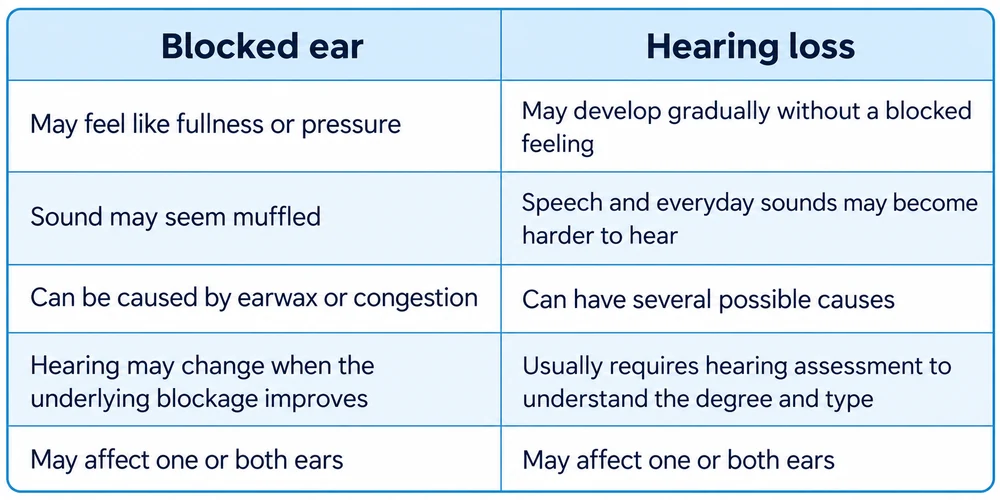
Blocked Ear vs Hearing Loss: What’s the Difference?
The symptoms can overlap, which is why it is not always possible to tell the difference yourself.
What Else Can Cause a Blocked or Muffled Ear?
Earwax is not the only possible explanation. Depending on the symptoms and circumstances, muffled or reduced hearing may also be associated with:
● Ear congestion or pressure changes
● Middle-ear problems
● Ear infections
● Eustachian tube dysfunction
● Noise exposure
● Age-related hearing changes
● Other conditions affectingthe ear or hearing system
Can a Hearing Test Tell If You Have Hearing Loss?
A comprehensive hearing assessment can provide a clearer picture of your hearing ability. Depending on your symptoms and clinical needs, an audiologist may use tests such as:
● Pure tone audiometry – measures how softly you can hear different frequencies.
● Speech audiometry – assesses aspects of how you hear and understand speech.
● Tympanometry – evaluates aspects of middle-ear function.
When Should You Have a Hearing Assessment?
Consider arranging a hearing assessment if:
● Your hearing has remained muffled or reduced
● You regularly ask people to repeat themselves
● Conversations are difficult to follow in noisy places
● You have noticed a gradual change in hearing
● You frequently increase the television volume
● You experience tinnitus alongside hearing changes
● One ear seems noticeably different from the other
● You are unsure whether earwax or hearing loss is affecting your hearing
What If Earwax Is Causing the Problem?
If an ear examination identifies earwax as a possible cause of the blocked sensation, appropriate ear-care advice can be provided. At Welfast Hearing, microsuction earwax removal may be available when clinically appropriate. Earwax removal is not suitable for every situation, so an assessment of the ear and your individual circumstances is important. If hearing remains reduced after wax removal, a hearing assessment may help determine whether another hearing issue is present.
Conclusion
A blocked or muffled ear can have different causes, and earwax is only one possibility. Hearing loss can also develop gradually without causing a clear feeling of blockage.
If you are experiencing persistent muffled hearing, difficulty understanding speech or changes in one or both ears, a professional hearing assessment can help provide a clearer picture of what may be affecting your hearing.
Welfast Hearing offers personalised hearing assessments and ear-care services across the Central Coast and Lake Macquarie. Understanding the cause of a hearing change is the first step towards choosing the most appropriate care.
Disclaimer
This article provides general hearing-health information and is not a substitute for an individual assessment or medical advice. Hearing concerns can have different causes. If you experience sudden or significant hearing loss, severe ear pain, discharge, dizziness or other concerning symptoms, seek prompt medical assessment.
FAQs
Can earwax cause temporary hearing loss?
No. A blocked sensation can have several possible causes, including earwax, congestion, middle-ear problems and other ear conditions. A persistent blocked feeling should be assessed rather than automatically assumed to be earwax.
Can earwax cause temporary hearing loss?
Earwax can block the ear canal and cause a temporary reduction or muffling of hearing. If hearing does not return after appropriate earwax management, further assessment may be needed.
How do I know if I have hearing loss or a blocked ear?
It can be difficult to tell based on symptoms alone because they can overlap. A hearing assessment can measure your hearing and help identify whether a measurable hearing difficulty is present.
When should I seek urgent medical attention?
A sudden or significant change in hearing, particularly if it develops quickly or occurs with other concerning symptoms, should receive prompt medical assessment. Do not assume sudden hearing changes are caused by earwax.