

If you have noticed that conversations are becoming harder to follow, you are turning up the television, or people seem to mumble more often, you may wonder whether you need a hearing screening or a full hearing test.
Although the terms are sometimes used interchangeably, hearing screening and comprehensive hearing testing are not the same. A screening is generally a quick check to identify whether further assessment may be needed. A comprehensive hearing test provides a more detailed assessment of your hearing and can help an audiologist understand the type and degree of any hearing difficulty.
Understanding the difference can help you choose the right next step for your hearing health.
What Is a Hearing Screening?
A hearing screening is a preliminary check designed to identify whether you may have a hearing difficulty.
It is usually quicker and less detailed than a comprehensive hearing assessment. Depending on the screening method, you may be asked to respond to sounds at different levels or frequencies.
A screening can be useful when you have no previous hearing assessment or want an initial indication of whether your hearing should be investigated further.
Important: A screening does not usually provide the same level of information as a diagnostic or comprehensive hearing assessment.
What Is a Comprehensive Hearing Test?
A comprehensive hearing test is a more detailed assessment performed by an audiologist.
Depending on your symptoms, history and clinical needs, your assessment may include different tests to evaluate how you hear sounds and speech.
These can include:
● Other assessments where clinically appropriate
The results help your audiologist understand your hearing profile and discuss appropriate next steps with you.
At Welfast Hearing, comprehensive hearing assessments are designed around your individual hearing concerns, with results explained clearly so you can understand what they mean for everyday communication. Most comprehensive appointments take approximately 45–90 minutes, depending on the assessment required.
Hearing Screening vs Hearing Test: What Is the Difference?
The simplest way to understand the difference is:
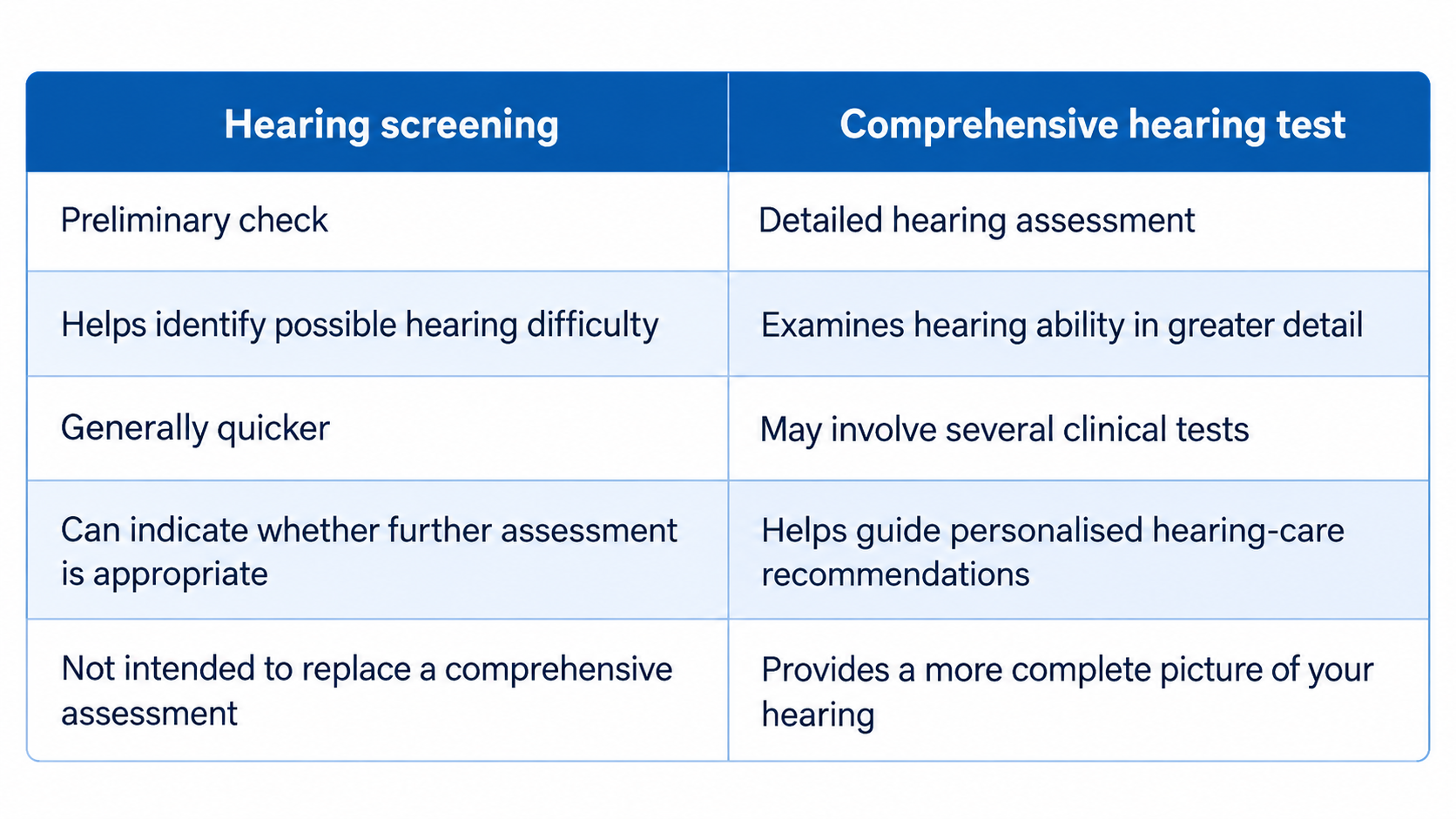
A screening can be a useful starting point, but if you are experiencing ongoing hearing difficulties, a comprehensive assessment may provide more useful information.
When Should You Have a Comprehensive Hearing Test?
You may want to consider a hearing assessment if you:
● Frequently ask people to repeat themselves
● Struggle to follow conversations in groups or noisy places
● Increase the volume on your television or phone
● Find speech sounds unclear or muffled
● Have noticed a gradual change in your hearing
● Experience tinnitus or ringing in your ears
● Have regular exposure to loud workplace noise
● Have previously been told that you may have hearing loss
● Are concerned about changes in a family member’s hearing
Hearing difficulties can develop gradually, so it is not always obvious that your hearing has changed.
Can a Hearing Test Tell You What Type of Hearing Difficulty You Have?
A comprehensive hearing assessment can provide much more information than a basic screening.
Your audiologist can assess hearing sensitivity and speech understanding and may use additional tests to investigate how the ear and hearing system are functioning.
The results can help your audiologist discuss whether monitoring, further investigation, hearing rehabilitation, hearing technology or another form of support may be appropriate.
For example, speech audiometry can help assess how well you understand speech at different presentation levels and can contribute to decisions about suitable hearing support.
What Happens After a Hearing Test?
Your audiologist should explain your results in clear, practical language rather than simply giving you a chart.
Depending on your results and individual circumstances, the next step may include:
● Monitoring your hearing over time
● Advice about hearing protection
● Further clinical assessment where appropriate
● Hearing aid discussion and fitting
● Hearing aid programming and aftercare
● Tinnitus support
● Referral to another healthcare professional when indicated
At Welfast Hearing, the focus is on independent, personalised hearing care rather than recommending the same solution for everyone.
Where Can You Have a Hearing Test on the Central Coast and Lake Macquarie?
Welfast Hearing provides independent hearing care across the Central Coast and Lake Macquarie, with clinics in:
● Morisset
The clinics provide access to hearing assessments and other hearing-care services, depending on the location and appointment requirements.
If travelling to a clinic is difficult, Welfast Hearing also offers home visit audiology, with availability best confirmed directly with the team.
Book a Hearing Assessment with Welfast Hearing
If you are unsure whether you need a hearing screening or comprehensive hearing test, the Welfast Hearing team can discuss your concerns and help determine the most appropriate appointment.
Welfast Hearing provides independent audiology care, comprehensive hearing tests, hearing aid fitting and aftercare, tinnitus support and ear-care services across the Central Coast and Lake Macquarie. Request an appointment at your preferred Welfast Hearing clinic.
Disclaimer: This article provides general hearing-health information and is not a substitute for an individual assessment or medical advice. Hearing concerns can have different causes. If you experience a sudden or significant change in hearing, seek prompt professional medical assessment.
FAQs
Is a hearing screening the same as a hearing test?
No. A screening is generally a preliminary check, while a comprehensive hearing test provides a more detailed assessment of hearing ability.
Is a comprehensive hearing test painful?
No. Hearing assessments are generally safe, non-invasive and painless.
Do I need a referral for a hearing test?
Usually, you can arrange a hearing assessment without a referral. However, referral requirements can vary depending on the funding program, insurer or specific circumstances.
How long does a hearing test take?
The appointment length depends on the assessments required. A comprehensive assessment at Welfast Hearing may take approximately 45–90 minutes.